How I price a project: the spreadsheet behind every quote

Three years ago I quoted £6,500 for a brand identity because the last one had been £6,000 and this one felt slightly bigger.
We delivered it in a hundred and forty hours across eleven weeks. That was £46.43 an hour against a team that cost me more than that to employ before I paid rent. I did not know that at the time. I found out the following February when the accounts came back and the year had gone sideways for reasons I could not name.
The spreadsheet in this piece is what I built afterwards. It has five tabs and it has never once produced a number that felt like the number I would have guessed.
Tab 1: what an hour actually costs me
This is the tab that changed how I quote.
A designer on £45,000 does not cost £45,000. For 2026 to 2027 I pay employer National Insurance at 15% on everything above a £5,000 secondary threshold, and a minimum 3% pension contribution on qualifying earnings between £6,240 and £50,270.
| Line | Amount |
|---|---|
| Salary | £45,000.00 |
| Employer National Insurance at 15% | £6,000.00 |
| Employer pension at 3% | £1,162.80 |
| Annual cost to the studio | £52,162.80 |
That is 15.9% on top of the salary, and I had been mentally pricing off the salary for four years.
Then the hours. A year is 52 weeks, but statutory leave is 5.6 weeks including bank holidays, and if I am honest about sickness, training and the days that vanish it is closer to 44.8 working weeks. At 37.5 hours that is 1,680 paid hours a year, and not one studio on earth bills all of them.
| Utilisation | Chargeable hours | Cost per chargeable hour |
|---|---|---|
| 60% | 1,008 | £51.75 |
| 70% | 1,176 | £44.36 |
| 80% | 1,344 | £38.81 |
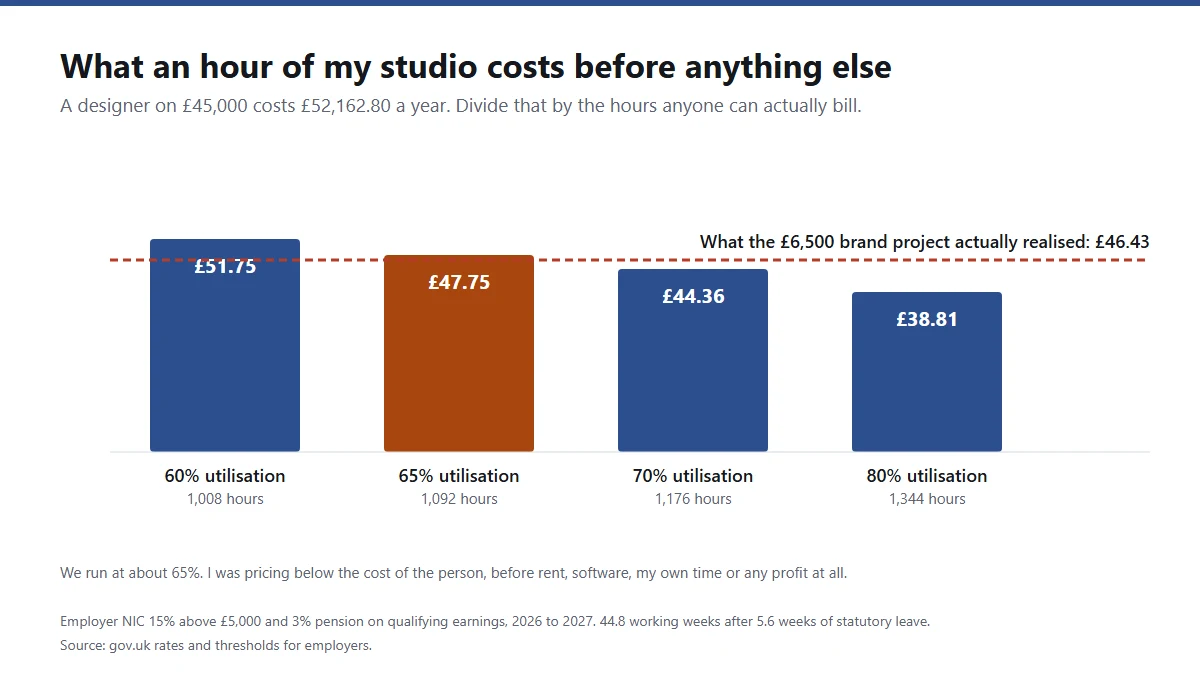
We run at about 65%. So my floor is roughly £47.75 an hour, for the person alone, before rent, software, my own time, or anything resembling profit.
The £6,500 brand identity realised £46.43. I was underwater on the first tab of the spreadsheet and I had no idea.
Tab 2: the hours, estimated by phase and then by person
I stopped estimating projects and started estimating phases, because I am reliably wrong about projects and roughly right about phases.
Every phase gets hours by person, not blended. A discovery week with me in it is not the same cost as a production week without me, and a blended rate hides exactly the thing I need to see: whether the project is profitable because of the production or in spite of the discovery.
The rule I now apply without exception: whatever number I write down first, I add the revisions round I have not been told about yet. Not as padding. As a line item, visible, with hours against it, which means when the client asks to remove it we are having a real conversation instead of me absorbing it in silence.
Tab 3: the things that are not hours
Fonts. Stock. Illustration or photography I will commission. Print tests. The subscription I will renew for one month because this project needs it.
These are small and they are the ones that quietly eat a margin, because every single one of them feels too minor to put in a quote and collectively they are four figures.
Tab 4: the risk column
One number, expressed as a percentage, applied to the hours total.
- A returning client with a defined scope: 0%
- A new client, clear scope: 10%
- Anything with more than two approvers: 20%
- Anything where the brief contains the phrase “we’ll know it when we see it”: 25%
This is not a stealth price rise. It is an estimate of how much more of my team a project will consume, based on the only evidence I have, which is every previous project of that shape.
The approver count is the strongest predictor I have found. Better than budget, better than sector, better than how organised the first meeting felt.
Tab 5: the quote, and the two dates
The output is a number, and two dates that matter more than the number.
The payment terms. Where no date is agreed, the law says payment is late 30 days after the client receives the invoice or I deliver, whichever is later. I now agree a date explicitly, because “30 days from delivery” and “30 days from receipt of invoice” are different weeks and the difference is my payroll.
The statutory interest line. I am entitled to 8% plus the Bank of England base rate on a late commercial invoice, without it being in the contract, because it is in the legislation. Bank Rate has been 3.75% since 30 July 2026 and is next reviewed on 17 September 2026, so today that is 11.75%.
I put that line in every quote now, while I am not annoyed with anybody. It has never caused an argument and the average days-to-payment has come down.
The mistake I still make
I quote the scope I was asked for rather than the scope the project actually needs.
A client asks for a brand identity. What they need is a brand identity and a fortnight of someone sitting with their sales team working out what they actually say. I know this by the second meeting. I put it in the quote maybe half the time, because the other half I am worried about the number getting too big and I tell myself we can deal with it later.
We deal with it later. Unpaid, in week nine, with everybody tired.
I have no clean solution to this. What I do now is price it as a separate optional phase with its own number, so that declining it is a decision the client makes rather than a corner I cut quietly.
The trade-off I have accepted
Costing to this level takes about ninety minutes per quote, and I lose some work because I am slower to respond than a studio that quotes off instinct in an afternoon.
I have decided that is fine, and I want to be honest that it is a real cost rather than pretending the spreadsheet is free. The projects I lose to a faster quote are disproportionately the ones with the vague brief and the four approvers. I have lost some good ones too.
What I would do
Build tab 1 this week, before anything else. You do not need the other four to benefit. Take one person’s salary, add 15% employer National Insurance above the £5,000 threshold and 3% pension, divide by a realistic number of chargeable hours, and look at the figure.
If your current rates are below it, you already know what the next conversation is.
Then put the statutory interest line in your terms, and agree the payment date explicitly rather than letting the default 30 days decide it for you.
And if you are anywhere near £90,000 of turnover in a rolling twelve months, the VAT registration threshold is going to arrive faster than you think and it changes every price on your rate card for clients who cannot reclaim it.
Updated on 15 September 2026.
Sources
- Gov.uk, rates and thresholds for employers 2026 to 2027
- Gov.uk, review of the automatic enrolment earnings trigger and qualifying earnings band for 2026/27
- Gov.uk, holiday entitlement
- Gov.uk, charging interest on a commercial debt
- Gov.uk, VAT registration: when to register
- Bank of England, the interest rate (Bank Rate)
Vurrle Studio is one studio owner writing about her own pricing alongside published employer rates. It is not accounting or financial advice.